
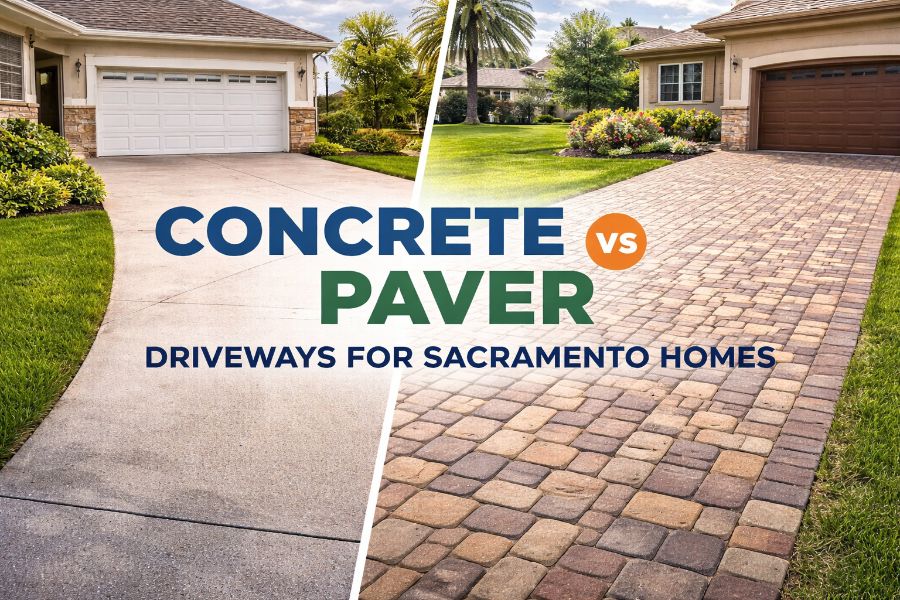
Concrete vs Paver Driveways for Sacramento Homes
Choosing the right driveway material is an important decision for any homeowner. Your driveway affects curb appeal, daily usability, long-term maintenance, and property value. In Sacramento, factors such as warm summers, soil movement, and drainage conditions play a major role in determining which driveway material performs best over time.
Two of the most popular options are concrete driveways and paver driveways. While both are durable and widely used, they differ significantly in cost, appearance, maintenance, and long-term performance. As a Sacramento concrete driveways contractor, we’ve created this guide to break down those differences so you can make the right choice for your home.
Understanding Concrete Driveways
What Is a Concrete Driveway?
A concrete driveway is created by pouring a continuous slab of concrete over a properly prepared base. Once cured, it forms a solid, seamless surface capable of supporting vehicle traffic for decades when installed correctly. Concrete driveways are especially popular in Sacramento due to their clean appearance, strength, and relatively quick installation time.
Advantages of Concrete Driveways
Concrete remains one of the most widely chosen driveway materials because of its practical benefits:
- Strong load-bearing capacity
- Lower upfront installation cost compared to pavers
- Fast installation and curing timeline
- Minimal day-to-day maintenance
Disadvantages of Concrete Driveways
Despite its durability, concrete does have limitations that homeowners should consider:
- Cracking can occur over time due to soil movement
- Repairs are often visible and difficult to blend
- Limited flexibility once poured
Understanding Paver Driveways
What Is a Paver Driveway?
A paver driveway is constructed using individual interlocking units placed over a compacted base. Instead of one solid slab, pavers create a flexible surface that can move slightly with soil shifts.
Paver driveways are commonly chosen by homeowners looking for high-end curb appeal and long-term durability.
Types of Pavers Used for Driveways
Several paver materials are popular for residential driveways:
- Concrete pavers (most common and cost-effective)
- Brick-style pavers for a classic look
- Natural stone pavers for premium aesthetics
Pros
Pavers offer several benefits that make them attractive for Sacramento homeowners:
- Excellent resistance to cracking
- Individual pavers can be replaced easily
- Wide range of colors, patterns, and designs
- Strong long-term durability
Cons
While visually appealing, paver driveways come with a few tradeoffs:
- Higher installation cost
- Longer installation timeline
- Ongoing maintenance to control weeds and joint sand loss
Concrete vs Paver Driveways: Cost Comparison (2026)
Cost is one of the most important factors when choosing a driveway material, but the cheapest upfront option is not always the least expensive over time. Installation price, repair costs, maintenance needs, and long-term value all play a role in the true cost of a driveway. In Sacramento, labor rates, material availability, and site conditions can also influence pricing.
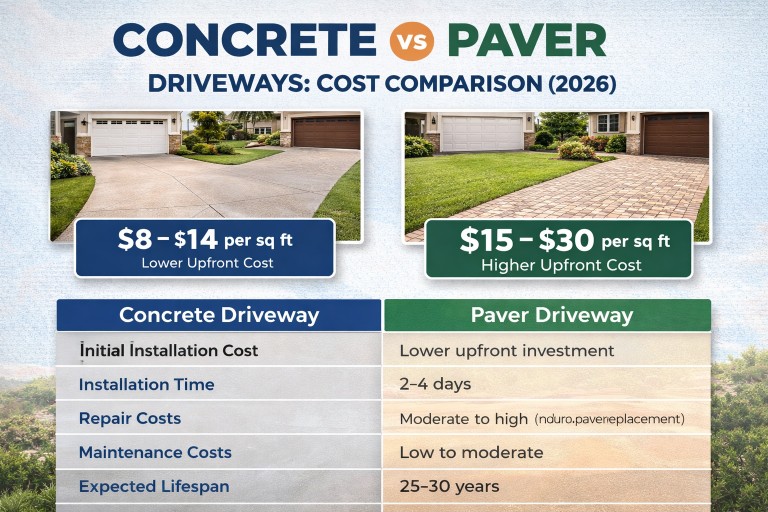
The table below shows average 2026 cost ranges for typical residential driveway installations.
Average Driveway Cost Comparison (2026 Estimates)
| Cost Factor | Concrete Driveway | Paver Driveway |
|---|---|---|
| Average Cost per Sq Ft | $8 – $14 | $15 – $30 |
| Initial Installation Cost | Lower upfront investment | Higher upfront investment |
| Installation Time | 2–4 days | 5–10 days |
| Repair Costs | Moderate to high (visible repairs) | Lower (individual paver replacement) |
| Maintenance Costs | Low to moderate | Moderate |
| Expected Lifespan | 25–30 years | 30–40+ years |
| Long-Term Value | Good | Excellent |
Driveway Cost Breakdown (2026 Estimates)
Concrete driveways are popular because they offer a lower initial installation cost while still delivering strong durability. For most homeowners, concrete remains the most budget-friendly driveway option, especially when decorative upgrades are kept minimal.
| Cost Component | Estimated Cost | What It Includes |
|---|---|---|
| Materials & Labor | $8 – $14 per sq ft | Concrete mix, base prep, pouring, finishing |
| Decorative Finishes | +$3 – $8 per sq ft | Stamped concrete, exposed aggregate, coloring |
| Sealing & Minor Maintenance | Low ongoing cost | Periodic sealing, basic crack prevention |
| Repair Costs | Moderate to High | Repairs often require cutting and replacing sections |
| Long-Term Cost Impact | Moderate | Lower upfront cost, higher visibility of repairs |
While concrete is affordable upfront, repairs can be more noticeable and may involve larger areas, which can increase long-term repair expenses if cracking occurs.
Paver Cost Breakdown (2026 Estimates)
Paver driveways require a higher upfront investment due to premium materials and labor-intensive installation. However, they offer superior design flexibility and easier long-term repairs.
| Cost Component | Estimated Cost | What It Includes |
|---|---|---|
| Materials & Labor | $15 – $30 per sq ft | Pavers, base prep, sand bedding, installation |
| Design Complexity | Variable increase | Patterns, borders, custom layouts |
| Maintenance Costs | Moderate | Joint sand replacement, weed control |
| Repair Costs | Low | Individual pavers replaced without large demolition |
| Long-Term Cost Impact | Lower over time | Higher upfront cost, cheaper and cleaner repairs |
Cost consideration:
Although pavers cost more initially, their modular design makes repairs easier and less expensive over time, which can balance out the higher installation price.
Durability and Lifespan Comparison
Both materials are durable, but they age differently depending on installation quality and maintenance.
| Feature | Concrete | Pavers |
|---|---|---|
| Expected Lifespan | 25–30 years | 30–40+ years |
| Crack Resistance | Moderate | High |
| Soil Movement Tolerance | Low | High |
| Heavy Vehicle Support | Good | Excellent |
Pavers generally perform better in areas where soil movement is common, while concrete performs well when the base is properly prepared.
How Sacramento’s Weather Affects Each Option
Heat and Temperature Changes
Sacramento experiences hot summers, which cause concrete to expand and contract. Over time, this movement can lead to surface cracks if control joints and reinforcement are not properly installed.
Pavers handle temperature changes better because their segmented design allows for slight movement without visible damage.
Soil Conditions and Drainage
Soil expansion and contraction are common in many Sacramento neighborhoods. Pavers adapt better to these conditions, while concrete relies heavily on proper base preparation and drainage design to avoid cracking.
Concrete vs Paver Driveways: Maintenance, Appearance & Value Comparison
Both concrete and paver driveways offer long-term durability, but they differ significantly in maintenance needs, visual appeal, and impact on home value. The table below highlights these differences to help homeowners quickly compare both options.
| Comparison Factor | Concrete Driveway | Paver Driveway |
|---|---|---|
| Routine Maintenance | Low to moderate | Moderate |
| Sealing / Joint Care | Sealing every 2–3 years | Joint sand replacement every 1–2 years |
| Ease of Repairs | Repairs are visible and less flexible | Individual pavers easily replaced |
| Weed Growth Risk | Very low | Moderate if not maintained |
| Overall Appearance | Clean, modern, uniform | Decorative, upscale, custom |
| Design Flexibility | Limited after installation | Very high (colors, patterns) |
| Long-Term Durability | High with proper care | Very high due to flexibility |
| Impact on Curb Appeal | Good | Excellent |
| Effect on Resale Value | Stable and practical | Often higher in premium areas |
| Best For | Budget-conscious homeowners | Homeowners seeking premium look |
This side-by-side comparison makes it clear that concrete driveways are ideal for homeowners seeking affordability and low upkeep, while paver driveways excel in customization, aesthetics, and long-term flexibility.
Which Driveway Is Best for Your Sacramento Home?
There is no single “best” driveway material for every home, only the option that best matches your budget, design preferences, and long-term expectations. Both concrete and paver driveways perform well in Sacramento when installed correctly, but they serve different homeowner priorities.
If you are looking for a cost-effective, durable, and low-maintenance solution, a concrete driveway is often the best choice. It provides a clean, modern appearance, installs quickly, and delivers reliable performance for decades with basic maintenance.
On the other hand, if curb appeal, customization, and long-term flexibility are your top priorities, a paver driveway may be the better investment. While the upfront cost is higher, pavers offer superior design options, easier repairs, and excellent durability in areas with soil movement.
Ultimately, the best choice depends on your property conditions, budget, and how you plan to use and maintain your driveway. A professional evaluation can help determine which material will perform best for your specific location.
1. Are concrete or paver driveways better for Sacramento’s climate?
Both materials perform well in Sacramento’s climate, but pavers handle soil movement and temperature changes better. Concrete works best when proper base preparation, reinforcement, and control joints are used.
2. Which driveway lasts longer: concrete or pavers?
Paver driveways typically last longer, often 30–40+ years, because individual units can move and be replaced. Concrete driveways usually last 25–30 years with proper maintenance.
3. Is a concrete driveway cheaper than a paver driveway?
Yes, concrete driveways generally have a lower upfront installation cost. Paver driveways cost more initially but may save money over time due to easier repairs.
4. Do paver driveways require more maintenance?
Yes, pavers require more routine maintenance, such as joint sand replacement and weed control. However, repairs are easier and less noticeable compared to concrete.
5. Does a paver driveway increase home value?
In many cases, yes. Paver driveways can improve curb appeal and increase perceived home value, especially in higher-end Sacramento neighborhoods.